

Most people think learning Spanish means memorizing endless verb charts and vocabulary lists. So that’s what they run to when they feel motivated to learn a new language, and then they give up. I’ve done this a lot. But there’s good news: Spanish is full of patterns and shortcuts that make it easier than you think.
By the end of this post, you’ll have a set of powerful hacks from a book I recently read called Madrigal’s Magic Key to Spanish. In my opinion, it’s better than Duolingo and will help you save time, skip the overwhelm, and actually start speaking Spanish fast.
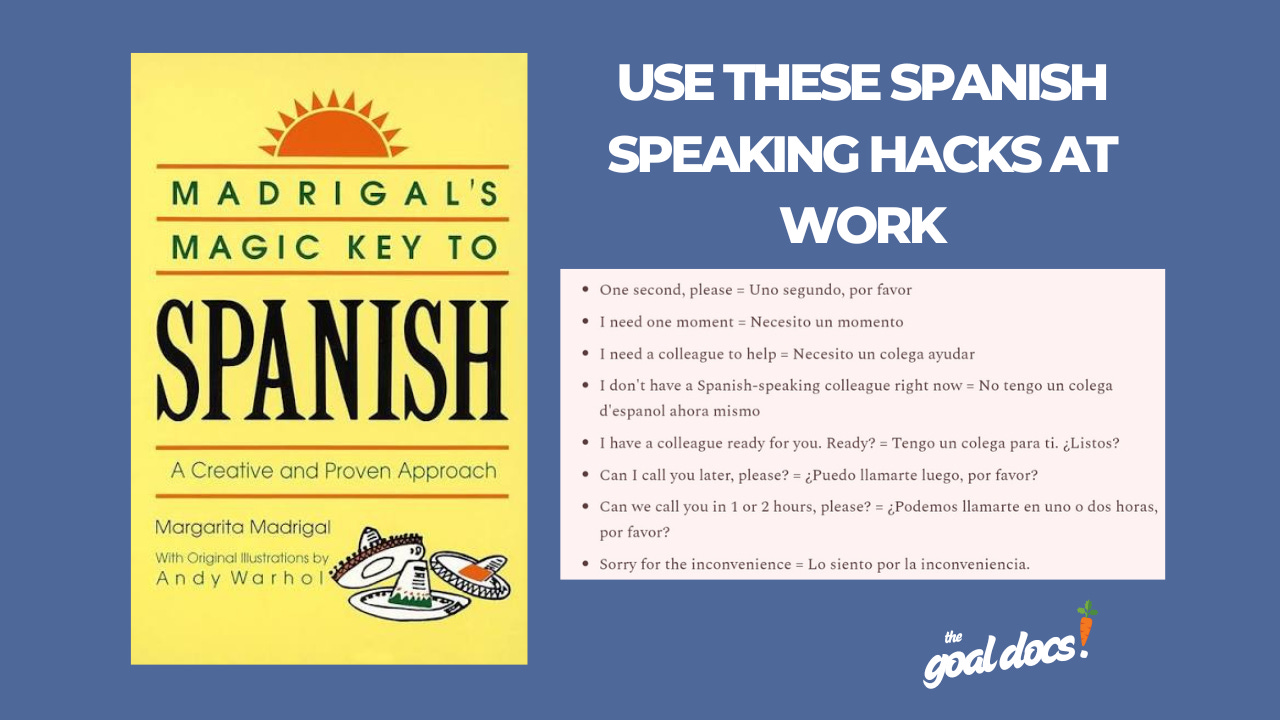
Hack 1: Spanish Shortcuts For Work
If you've ever worked in a space that requires you to answer incoming or inbound calls, you know the pain of getting a call from someone who only speaks Spanish and you can't help them because you don't speak their language. It sucks.
So to get around this issue at my job, I put together a cheat sheet of words and phrases I can use to at least help me transfer the call to a teammate who speaks fluent Spanish. Here it is:
One second, please = Uno segundo, por favor
I need one moment = Necesito un momento
I need a colleague to help = Necesito un colega ayudar
I don't have a Spanish-speaking colleague right now = No tengo un colega d'espanol ahora mismo
I have a colleague ready for you. Ready? = Tengo un colega para ti. ¿Listos?
Can I call you later, please? = ¿Puedo llamarte luego, por favor?
Can we call you in 1 or 2 hours, please? = ¿Podemos llamarte en uno o dos horas, por favor?
Sorry for the inconvenience = Lo siento por la inconveniencia.
Hack 2: Turn English Words into Spanish Instantly
Here’s a big secret… many Spanish words are almost identical to English. All you need to do is see some of these patterns:
For words ending in CT, add “O”.
exact = exacto
abstract = abstracto
For words ending in TY, replace TY with DAD.
activity = actividad
identity = identidad
For words ending in RY, replace RY with RIO.
necessary = necesario
itinerary = itinerario
For words ending in CY, replace CY with CIA.
agency = agencia
urgency = urgencia
For words ending in OUS, replace OUS with OSO.
famous = famoso
delicious = delicioso
With these hacks, you already know hundreds of Spanish words without even trying.
Hack 3: Fast-Track Verbs with Simple Endings
When you want to say what you’re currently doing, use these 2 shortcuts for making a verb end in “-ing”:
Add ANDO for “-ing” with AR verbs.
So hablar(to speak) = hablando(speaking)
Add IENDO for “-ing” with ER/IR verbs.
So escribir(to write) = escribiendo(writing)
You can do a lot with those two rules. But you’ll need some verbs to add “-ing” to. Here are some of the verbs I find myself using most commonly: ser/estar(to be), tener(to have), hacer(to do/make), ir(to go), poder(can/be able), and querer(to want).
For the verb “estar”, you’ll most commonly say “estoy”, which means “I am”.
For the verb “tener”, you’ll most commonly say “tengo”, which means “I have”.
Or you will say “tienes”, which means “you have”.
For the verb “poder”, you’ll most commonly say “puedo”, which means “I can”.
Or you will say “puedes”, which means “can you…”
For the verb “querer”, you’ll most commonly say “quiero”, which means “I want”.
Or you will say “quieres”, which means “you want”.
Finally, for the verb “ir”, you’ll most commonly say “voy”, which means “I go”.
Hack 4: Use “Voy a” for Future Plans
Want to talk about the future without memorizing new verb endings? Just use “voy a” (I’m going to) + verb.
Voy a estudiar = I’m going to study
Voy a comprar una casa = I’m going to buy a house
Van a jugar baloncesto = They’re going to play basketball
You can sound fluent today by mastering this one phrase.
Hack 5: Spot Gender and Plural Rules Fast
Words ending in dad, -sion, -cion, -cia, -tad, -ina are feminine, so use la/una instead of el/un.
la universidad
la conversacion
la independencia
To make nouns plural:
If it ends in a vowel(a,e,i,o,u), then add “s”. So casa = casas.
If it ends in a consonant(NOT a,e,i,o,u), then add “es”. So doctor = doctores.
These shortcuts will save you from guessing every time in whether a word is feminine or masculine and how to make a word plural. Those sometimes make me stumble when I’m forming a sentence.
Hack 6: Everyday Phrases You’ll Actually Use
Here are some practical, high-frequency phrases that I’ve used regularly in conversations:
¿Dónde está…? = Where is…?
¿Cómo está…? = How is/How are…?
¿Cómo se dice…? = How is/How are…?
No lo sé = I don’t know it
Lo tengo or No lo tengo = I have it or I don’t have it.
Ten buenos dias = Have a good day
¿Puede hablar mas despacio, por favor? = Can you speak more slowly please?
Estoy = I am…
Su = His/her
Key things you’ll also want to learn are:
Days of the week
Numbers 1 through 1000
Who, what, when, where, which, and how
Night, day, midnight, noon, morning.
Day, week, month, year
Here and there(”aqui” and “ahi”)
Right and left(”derecha” and “izquierda”)
These are good building blocks for the Spanish conversations you’ll start having soon.
How to Actually Practice These Hacks (Without Feeling Awkward)
Here’s a tough truth: knowing hacks is cool, but you HAVE TO actually use them if you want them to stick. The best ways I’ve found to practice are:
TalkPal App – This app is great. It lets you practice speaking Spanish out loud, kind of like a digital conversation partner that never gets tired. Perfect for building confidence.
Taking Ubers – Sounds random, but it works. I’ll somewhat regularly get an Uber driver who only speaks Spanish. And if I need to give them directions, I have to use Spanish. It’s like the reverse of the normal problem. You’re not trying to understand them, you’re trying to be understood. And here’s the cool part: even when my Spanish isn’t perfect (sometimes straight up wrong), Uber drivers usually love helping me say it the right way. They genuinely appreciate the effort of you trying Spanish instead of forcing them to figure out your English.
Spanish Media – I love basketball and I wanted a way to hear people speak Spanish, so I started to exclusively listen to Spanish basketball media. The channels I listen to the most are “ESPN Deportes” and “PlanetaNBA”. I’ve also started watching soccer because of ESPN. My favorite player right now is Lamine Yamal. If sports isn’t your thing, I also found this cool channel that talks about random interesting things called “Luisito Comunica”. I love sports, so I listen to these shows at least once a day for news.
Between these three, you’ll actually get real-world practice, which is what takes you from “knowing hacks” to “actually speaking Spanish.” Then, there’s a fourth way to practice Spanish that I’ve found super helpful the more I hear and speak it:
Use Quizlet – Yup, the same website you used to cram for your tests in high school and college can help you learn Spanish fast. Whenever I’d hear a new word or an Uber driver would tell me to start using a certain phrase instead of what I was saying before, I’d write it down in a Quizlet set that I call “Nick’s common Spanish words”. Then, once a day I’ll try to study the set and build up a streak on the app. They even give you fun memorizing games to keep the learning interesting. I’d recommend doing this for anyone.
Conclusion: Your Shortcut to Spanish Fluency
Learning Spanish doesn’t have to be painful. With these hacks, you’re skipping the grind and getting straight to fluency.
Use the hacks from this article.
Most importantly, practice with apps like TalkPal or real people (like your Uber driver).
If you do that daily, Spanish will click faster than you expect and you’ll finally escape the frustration most learners get stuck in. It’s working for me and I think it’ll work for you too.